Skip to content

For university STEM students.

That moment
it all clicks.

Turn your lecture slides into explanations, practice and a clearer idea of what to revise next. An AI study workspace, organised around your modules.

Join the Wishlist Try a sample lecture

Wishlist access is open. Already invited? Sign in

Your lectures Your understanding Your next step

From the first lecture to the final exam.

Your material. A whole new way in.

Your lecture.
Let's make it click.

Upload your slides or notes. Ask about the bit that didn't make sense, practise it, and see what to revisit before the exam.

NovaComputer Science Graph algorithmsInteractive example

Your course, in its own words.

It starts with
your lecture.

PDFs. PowerPoints. Documents. Your own notes. Bring one lecture and try a different way through it.

PDFPPTXDOCXNotes
Graph algorithmsLecture 04

Breadth-first search

Explore a graph one layer at a time.

A queue keeps nodes in discovery order.

Your original source stays close.08 / 24

Stay with the idea.

Watch the idea
fall into place.

Get an explanation grounded in your source, with a trail back to the slide. Keep your own notes beside it.

A queue keeps nodes in discovery order.
✳ Nova explains

Why does the queue matter?

Queue Next →
A

Start at A. A queue takes the oldest waiting node first.

0 / 6 visited

From “I get it” to “I can do it”.

A little thinking.
A lot more clarity.

Guided Study, question practice and flashcards help you work with the idea. Try first, then get support where you need it.

Question practice · Give it a go

Why does BFS find a shortest path in an unweighted graph?

Choose an answer to see how feedback works.

A clearer place to go next.

Your work tells
the story.

Nova uses your submitted attempts to show what is improving and what needs another look. Untested stays untested.

Join the Wishlist

Wishlist access is open. Already invited? Sign in

Your answers in this example

Graph algorithms

00of 03 ideas tried
Evidence starts with your attempt.
BFS & shortest pathsNot yet tested
Depth-first searchNot yet tested
Weighted graphsNot yet tested
A useful next step

Give one idea a starting point.

Try the question. Only the idea it tests will change.

Reading an explanation alone never counts as evidence.

For the shape of your day.

Your degree.
Your everyday.

A gap between lectures. A module to get your head around. Revision with no obvious starting point. There is a way in.

A small gap.
A useful next step.

Home offers up to four optional study suggestions. Personalised Study draws on your attempts, untested ideas and topics due another look. Choose a short, medium or long session to suit the time you have.

Example recommendation Give graph traversal
another look.

Algorithms · Medium session
12 to 18 active minutes

Explore the workspace
Your week, with a place to start.
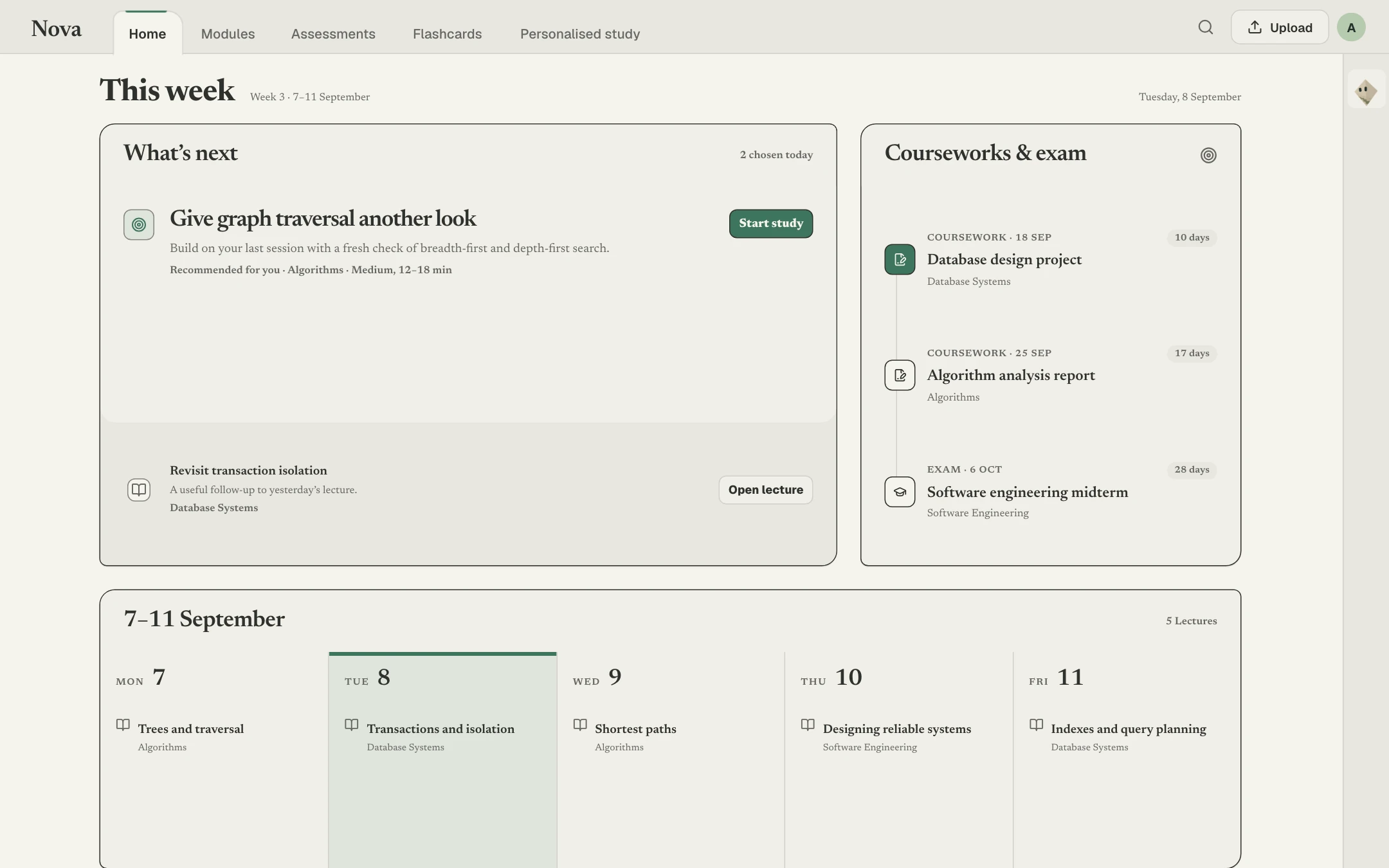
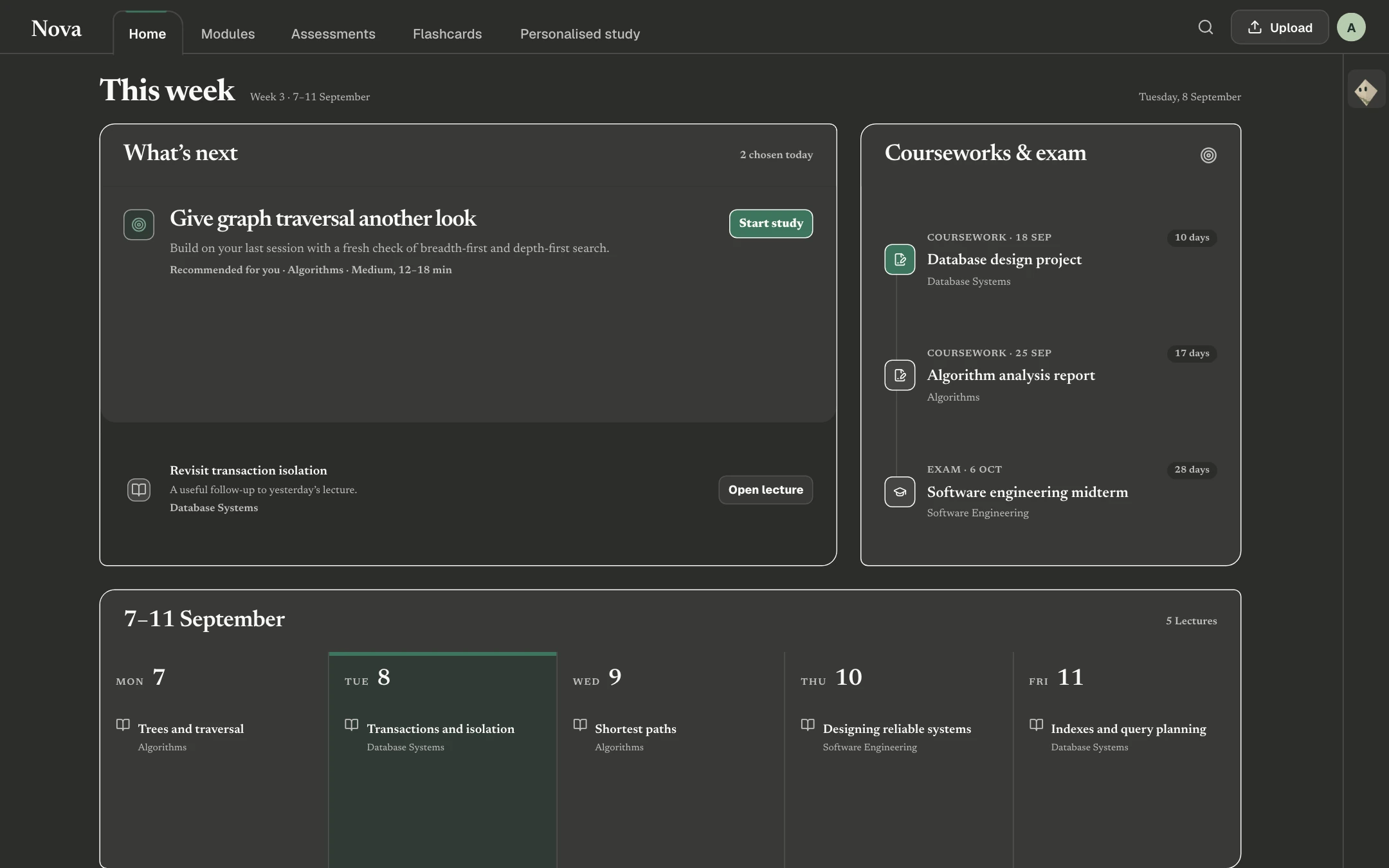
Nova weekly workspace with a graph traversal study recommendation, coursework deadlines and lectures. Nova weekly workspace with a graph traversal study recommendation, coursework deadlines and lectures.

One module.
All the pieces.

The slides from last week. The notes you made today. Keep your lectures, sources and study material together in the shape of your course.

Open your next lecture Graph traversal.

Open the source. Ask about the idea.
Keep your own notes beside it.

Explore the workspace
Your course, in a familiar shape.
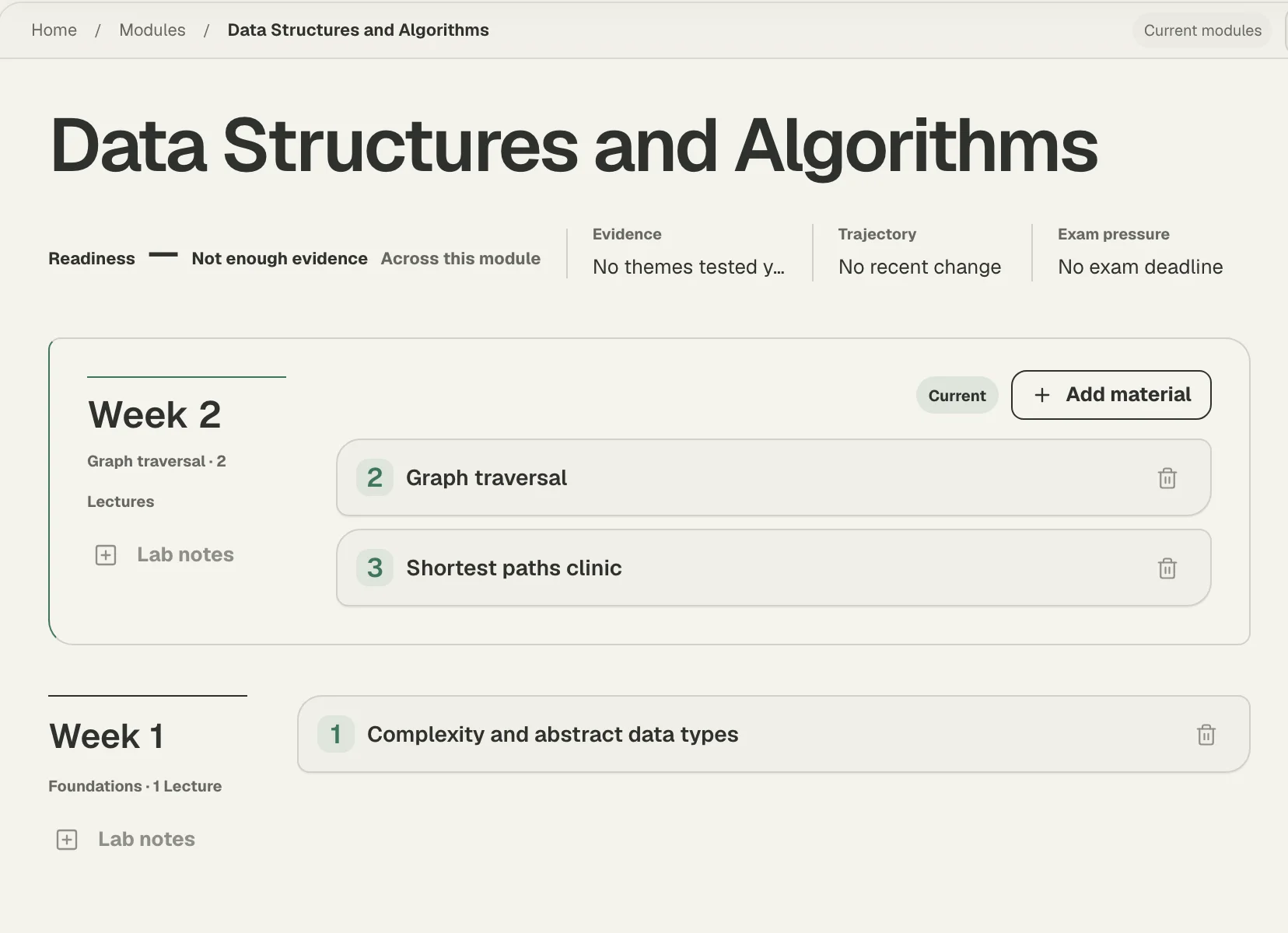
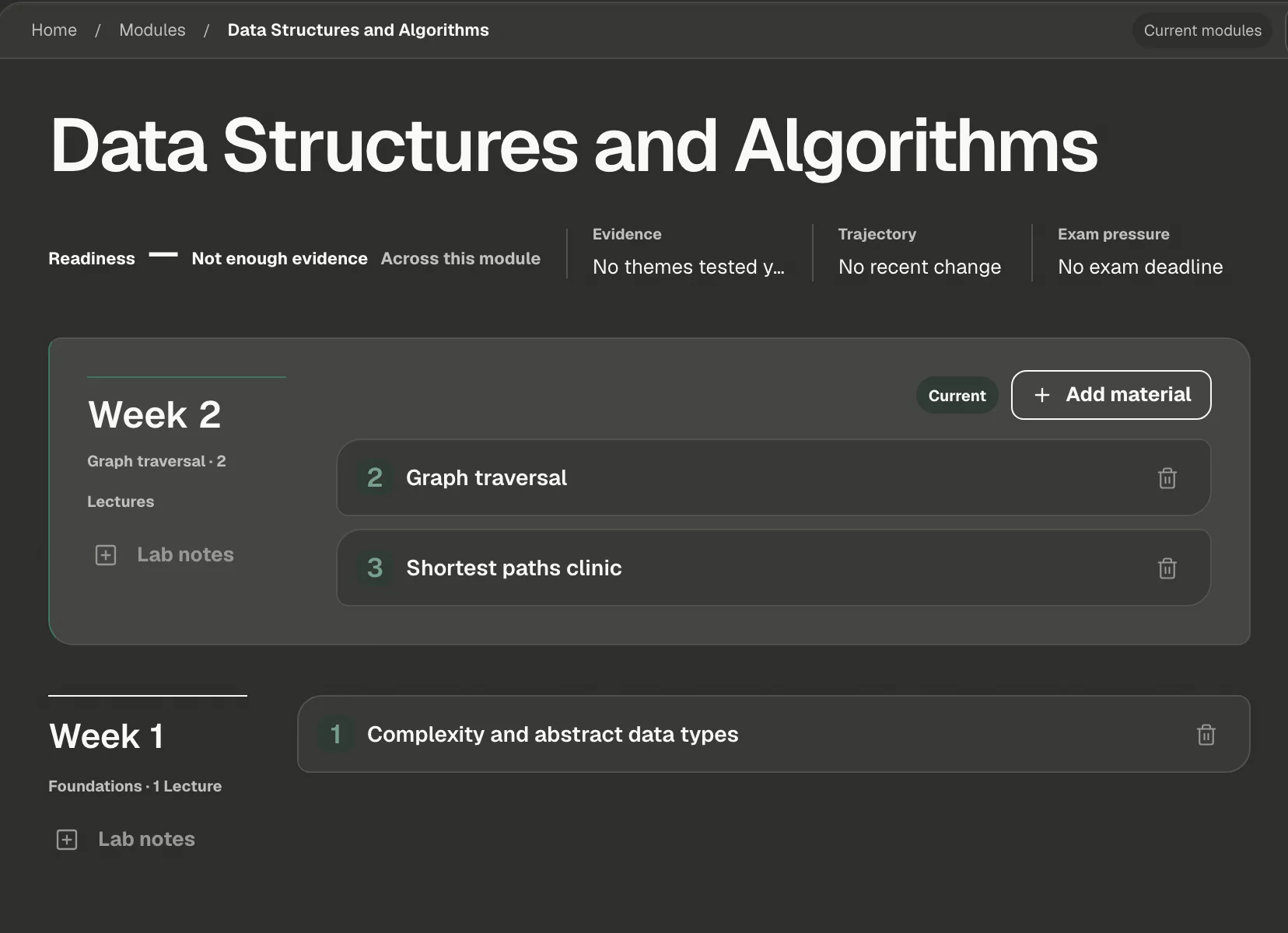
Nova module workspace with graph traversal and shortest paths lectures organised by week. Nova module workspace with graph traversal and shortest paths lectures organised by week.

Less guesswork.
A clearer next move.

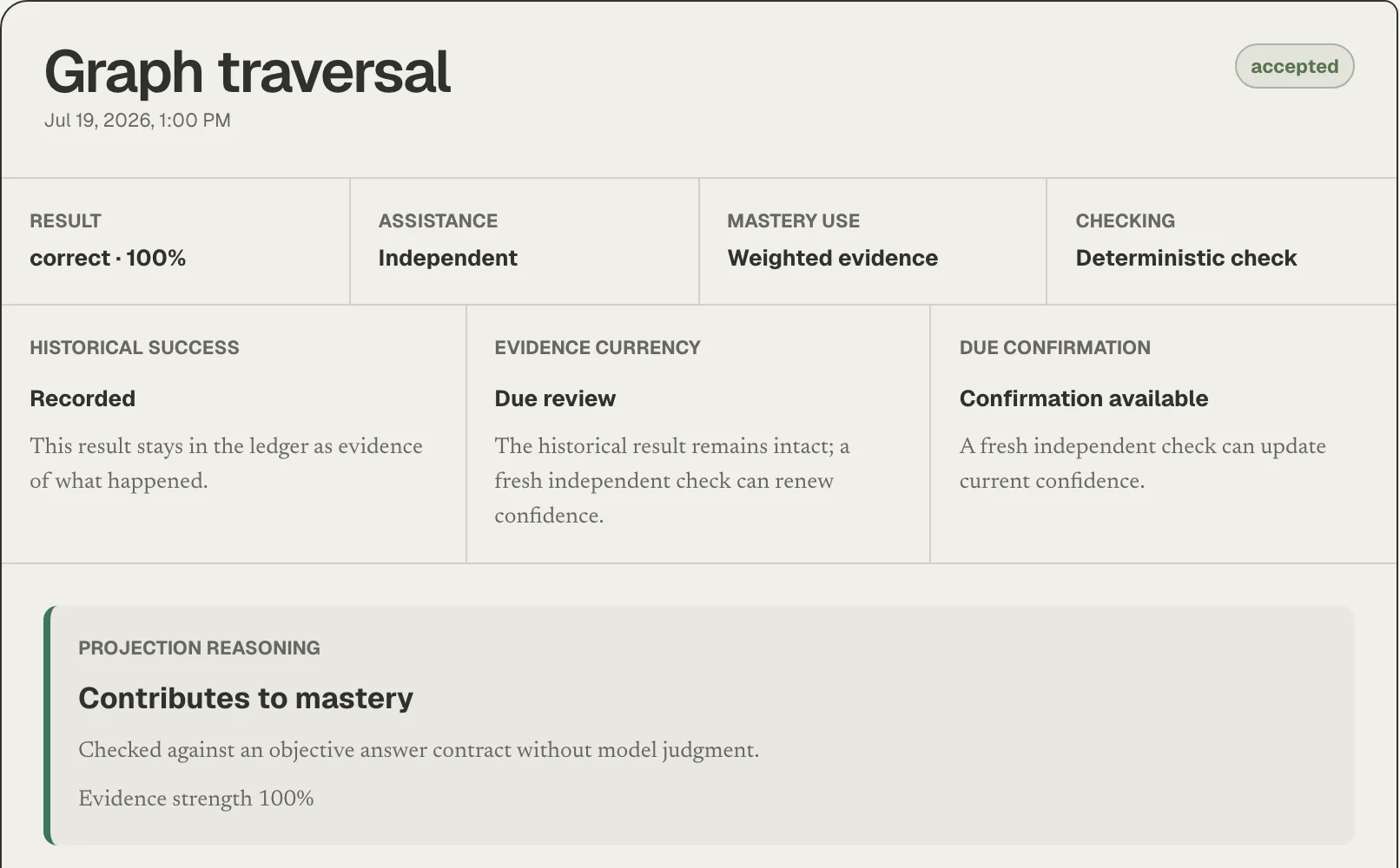
See what your attempts have shown and what is due another look. Your previous work stays part of the picture; ideas you haven't tested stay untested.

In this example Graph traversal.
Due another look.

An earlier answer showed understanding.
A fresh attempt can check it again.

Explore the workspace
Your progress has a history.
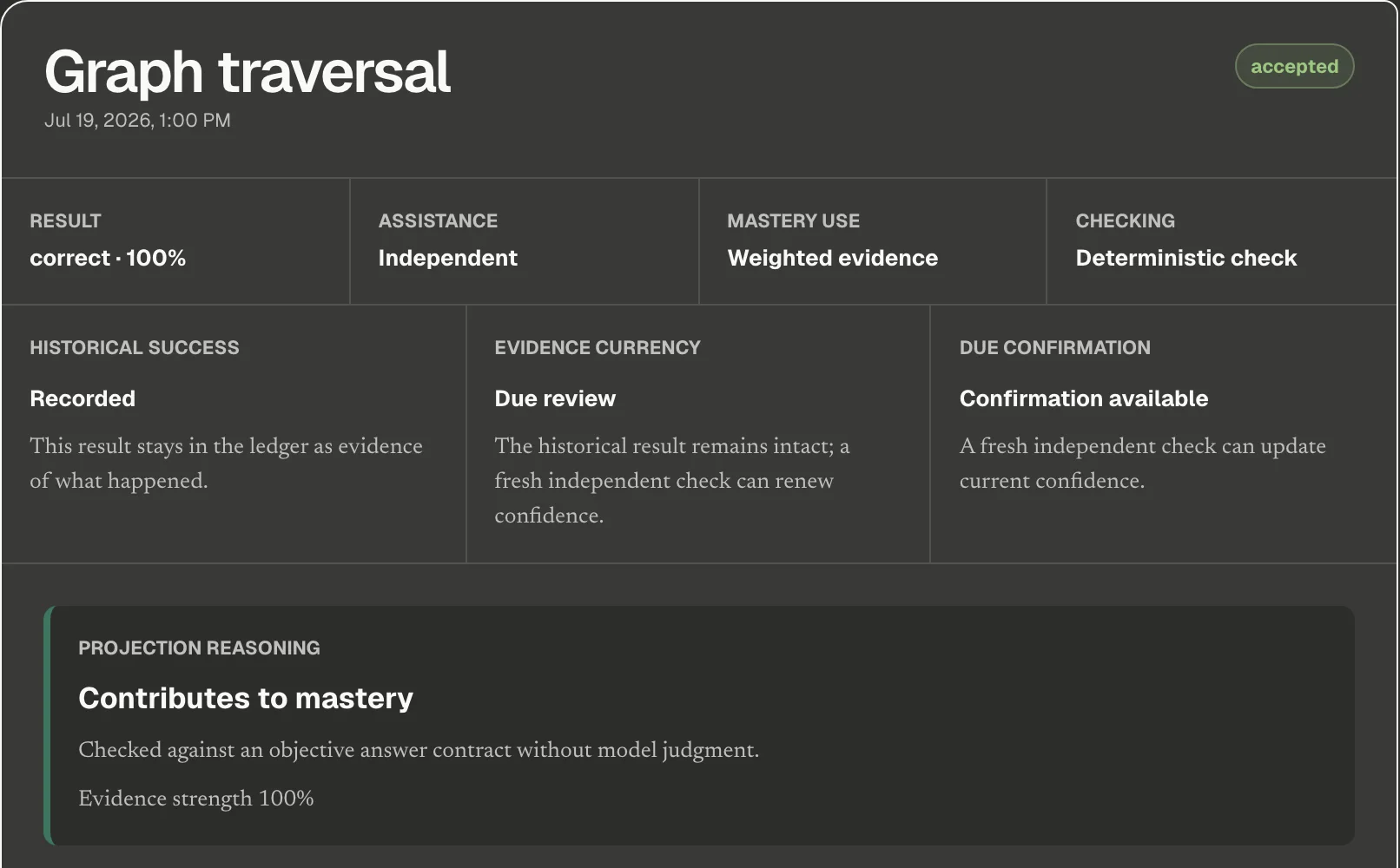
Nova graph traversal evidence showing a previously correct independent attempt that is due review. Nova graph traversal evidence showing a previously correct independent attempt that is due review.

The bigger picture.

Ideas don't live
in separate lectures.

Neither should your understanding. Explore how Nova connects concepts, keeps their sources close, and uses evidence to suggest a next step.

A whole course, connected.

Nova builds your study map from your lectures, slides and worksheets.

For the weeks that get away from you.

A way back in.
At your pace.

Missed a few lectures? Choose where you last felt comfortable and where you need to rejoin. Catch-up Study helps you find a route back into the material.

See what a study session feels like

Try a route through an example module.

Two lectures to reconnect.

First lecture in the gap Graph traversal

The gap starts after your last comfortable lecture. Nova also checks the prerequisites it depends on.

  1. Graph basicsEarlier lecture
  2. Stacks and queuesLast comfortable
  3. Graph traversalIn your gap
  4. Shortest pathsRejoin here

Illustrative lecture sequence. Your route uses your own module and sources.

And when it's time
to put it all together.

Past paperAlgorithms

Show your working.

Question 2Compare breadth-first and depth-first search. Explain how the choice of data structure changes the traversal order.

Type in Novaor write by hand

Time remaining38:42

Your attached mark schemeAvailable after submission

Illustrative past-paper sitting

Make the exam feel less unknown.

Sit your past paper with a timer. Type your answers or write by hand and upload your script afterwards. If you attach a mark scheme, it opens after submission.

Coursework reviewAlgorithms
From your rubric
“Compare approaches and justify your choice.”
Your draft · paragraph 4

“I chose BFS because it finds a path with the fewest edges.”

Nova’s revision question

What changes if the edges have different weights?

Your next sentence is yours to write.
Illustrative rubric and student draft

See how your draft meets the rubric.

Check what your draft demonstrates against the rubric you attach. Get questions that help you revise it, while the writing stays yours.

Your study workspace.
£8 a month.

Try Nova Plus for 14 days with no card. If it works for you, choose how you pay. Both options include the same workspace and allowances.

Monthly

Nova Plus

£8a month

Keep it flexible. Renews monthly until you cancel. Cancel automatic renewal at any time.

Sign in

Four months

Save £2

£30every four months

Plan ahead for four months. £7.50 a month equivalent. Renews every four months until you cancel.

Sign in

Nova Plus includes 40 source preparations, 100 study sessions and 500 assisted interactions per rolling 30 days. Page limits and annual preparation limits also apply.

Prices in GBP. Your 14-day trial starts when you verify your account. You only pay if you choose a subscription, through Stripe checkout inside Nova.

A few things
you might be wondering.

A new way to study should be easy to get your head around.

What do I need to get started?

Create a module and add a lecture. You can upload PDF, PowerPoint (.pptx), Word (.docx), text or Markdown files, or paste your notes. Nova prepares the material so you can explore it and start studying.

How is this different from a chatbot?

Nova keeps your course material, notes and study attempts connected across sessions. You can ask questions, but you can also practise, get feedback and use what your answers showed to shape your next session.

Will Nova work for my course?

Nova is currently built for students aged 18 and over on lecture-based STEM degrees at UK universities. It works from the material you add, so it follows your lecturer's course. Explore course fit.

What happens after the free trial?

You choose whether to subscribe. No card is needed for the trial, so you won't be charged automatically. Without a subscription, new AI preparation pauses and your existing material stays readable. See plans and allowances.

Bring your next lecture.
See what clicks.

Your slides. Your questions. Your next lightbulb moment.

Join the Wishlist

Wishlist access is open. Already invited? Sign in